
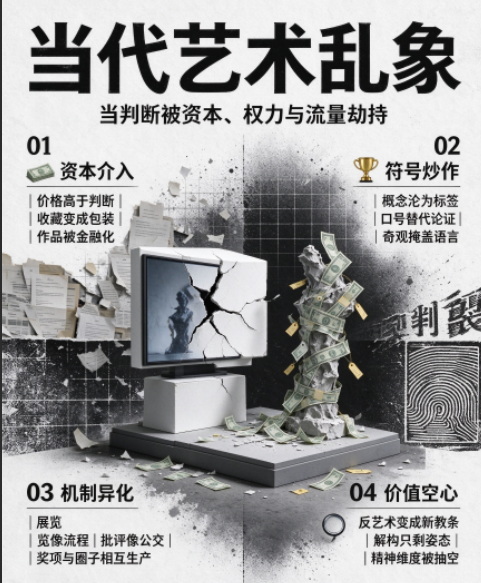
注:配图由AI生成
谈起当代艺术种种乱象,我们很容易习惯性向外寻找理由。会把问题推给市场、推给机制、推给时代环境。仿佛市场出了问题,才带坏了艺术。
但这里有一个绕不开的事实:市场是人构建出来的,评判标准是人写出来的,展览、史论叙事、行业规则,全部都是人一手造就。市场本身没有意志,无所谓好与坏,萧条或者火热,都只是外在表象。环境只是结果,不是病根。
真正的病灶,不在外部世界,而在身处这个行业之内,每一个人的生命内部。
一切艺术危机的本质,是人的生命危机。是一大批艺术家、史论家、传播者、行业从业者,灵性乃至灵魂层面的隐性死亡。
不是某一部分人,是整条链条上的人。创作的人,写史的人,做评判做传播做交易的人,都包含在内。当人的灵魂失守,精神底线消融,无论外部环境如何,虚假、功利、投机的乱象一定会生长出来。
一、艺术,是一个人完整生命状态的投射
艺术永远绕不开一个朴素真相:技法可以学习,套路可以批量习得,形式可以模仿复制,唯独生命质感、灵魂感知,没有办法后天伪造。
我们今天不缺技术娴熟的创作者,不缺懂得媒介、懂得话术、熟悉整套当代艺术范式的人。很多人手上功夫足够,对各种流派、外来图示了然于心,能做出看上去非常标准的当代作品。
可作品里面没有生命的重量。没有真切的生命体悟,没有精神的叩问,没有真诚的感受。
艺术从来不是材料、技法、概念的简单拼接。作品就是人精神世界的镜子。一个人内心丰盈、感知敏锐、灵魂经过洗礼,有精神底线,他的表达自然自带力量。倘若灵魂被欲望裹挟,精神底色浑浊,哪怕技艺再精湛,产出的也只会是徒有外壳的产物。
作品的空洞、虚假、同质化,不是技法的问题,是背后那个人的生命状态直接暴露在了作品之上。这是掩饰不住的。
二、灵性衰退,来自人自身人性弱点的持续侵蚀
原点就在这里:人如果不去优先关照自己的灵命与灵魂状态,不去自省、不去守护精神纯度,人性本能里的虚荣、贪婪、投机、从众,就会慢慢占据主导。
这里不是在做道德审判。人性自带软弱,这是所有人都要面对的现实。灵性不是与生俱来就可以永久保存的东西,它需要人主动守护。放弃向内审视,灵魂就会慢慢被世俗欲望侵蚀,一步步失去原本的纯粹,精神底线不断后撤。
落到艺术行业的整条链条,就会出现连锁的变质。
对于艺术家:创作不再是生命体验的抒发。做作品优先考虑的,是好不好参展、能不能获得圈内认可、能不能换取现实利益。独立思考让位给潮流风向,真实感受让位给套路范式。
对于史论、批评研究者:不再以真诚的精神判断去看待作品。写评述、梳理艺术叙事,掺杂人情、圈层立场、功利算计。把模仿、移植过来的圈层产物,包装成正统的艺术历史。
对于市场、传播的从业者:评判作品的标尺,不再关乎精神内核,更多看流量、看噱头、看可变现的价值。怎么有利可图就怎么运作。
市场不会主动制造虚假艺术,是人灵魂失守之后,亲手制造出虚假的市场与虚假的行业标准。
不是环境把人带坏,是人内在精神崩塌之后,共同造出了一个扭曲的行业环境。把问题推给市场,其实是一种向外的逃避。
三、集体灵魂失守,造就行业里的 “假性艺术生态”
今天我们看到的行业怪现状,是一整条链条集体失魂带来的结果。
大家熟练掌握整套行业游戏规则:会用前卫的形式,会讲晦涩的学术话术,懂得怎么包装人设,懂得怎么迎合圈层的审美。创作者、写史的人、做评判的人,都深谙这套玩法。
可很多人已经丢掉最根本的东西:精神的底线。何为好坏,何为真诚,何为独立的生命表达,这些标尺慢慢模糊。怎么做有利,就怎么做。
于是就出现很荒诞的现实:大量被展览记录、被文本记录下来的作品与叙事,经过时间大浪淘沙,根本不配留在艺术史之中。看上去热热闹闹,有展览、有画册、有图文图录,可缺少灵魂的支撑,时间一到就会被彻底冲刷淘汰。
图录不等于史料,记录不等于历史。一堆图片、一堆文字档案留存下来,如果背后没有灵魂与精神的支撑,也只是行业热闹过的痕迹,并不是真正的艺术。
这也解释,为什么很多被圈内奉为正统的叙事,放到更大的视野之下,很难被理解和接纳。根源并不是外界看不懂形式,而是整套叙事本身,就缺少精神内核的支撑。
这不是外界的偏见,是人自身灵魂失守种下的结果。
四、向外求全部没有出路,问题只能向内看见
很多人还在不停向外寻找解法。追求新媒介、新观念,期盼环境变好,期盼市场回归理性,寄希望外部力量来拯救艺术。
但如果身处行业之中的人,灵魂没有觉醒,精神没有回归,所有外部的改变都是治标不治本。环境可以改变,规则可以改写,可只要人的内心依旧被欲望裹挟,投机与虚假依旧会换一副模样重新生长。
艺术真正的迭代,从来不是形式、材料、话术的迭代,是人的迭代。是创作者、史论写作者、传播者,每一个人回到自身,重新守护自己的灵魂,重建精神底线,恢复真实的生命感知。
技法可以不断更新,理论可以不停学习,但灵魂的洗礼,精神的自省,没有任何人可以代替你来完成。
你是什么样的生命状态,你输出的艺术、你写下的历史评判,就会是什么样子。
结语:大浪淘沙,淘洗的终究是人本身
历史对艺术的筛选,从来不是筛选技法、筛选名头、筛选展览履历。时间最终筛掉的,就是灵魂缺席的一切。
不管时代是热闹还是冷清,市场是火爆还是沉寂,都改变不了这个底层逻辑。行业所有乱象,根源不在别处,就在我们每一个身处其中的人身上。
人的灵魂失守,艺术便随之衰败。人守住精神的底色,艺术才拥有真正向前的可能。
The root of all chaos in contemporary art never lies in the market, but in the spiritual disorientation of people across the entire industry.
When we talk about the various chaos in contemporary art, we tend to look for external explanations. We attribute the problems to the market, institutions and the social‑historical environment, as if a flawed market has corrupted art.
Yet there is an unavoidable fact: markets are constructed by human beings; evaluation criteria are written by human beings. Exhibitions, art‑historical narratives and industry rules are all created entirely by people. The market itself has no will of its own. It is neither good nor bad. Prosperity or recession are merely external phenomena. Circumstances are consequences, not root causes.
The real illness lies not in the outer world, but within the inner life of every person working in this industry.
The essence of every art crisis is a human existential crisis. It is the latent death of spirituality and soul among a great many artists, art historians, commentators and industry practitioners.
This applies not to a small group alone, but to the whole industrial chain: creators, historians, critics, communicators and dealers. When souls are compromised and spiritual boundaries dissolve, phenomena of falseness, utilitarianism and opportunism are bound to emerge, regardless of external conditions.
Ⅰ. Art is the projection of a person’s complete state of being
There is a plain truth about art: technical skills can be learned; formulas can be acquired in bulk; forms can be imitated and copied. Yet the texture of life and spiritual perception cannot be counterfeited after the fact.
Today we have no shortage of technically skilled creators, people familiar with media, rhetoric and the full set of contemporary‑art paradigms. Many possess solid craftsmanship, know diverse schools and imported visual languages, and are capable of producing seemingly standard contemporary works.
Still, their work carries no weight of lived life. It lacks genuine life experience, spiritual inquiry and authentic feeling.
Art is never a simple assembly of materials, techniques and concepts. An artwork is a mirror of its maker’s inner world. When a person is inwardly rich, perceptive, spiritually refined and guided by moral integrity, their expression naturally bears power. If the soul is seized by desire and the inner spirit muddied, even supreme craftsmanship yields nothing but hollow shells.
The emptiness, falseness and homogenization of artworks are not failures of technique. They are the unmasked reflection of the creator’s inner condition, which cannot be concealed.
Ⅱ. The decline of spirituality: constant erosion by human frailty
This is where it originates: if one fails to tend to one’s inner spiritual life, to practise self‑reflection and preserve spiritual integrity, vanity, greed, opportunism and conformism inherent in human nature will gradually take over.
This is not moral judgment. Human beings are inherently fallible. Spirituality is not a permanent innate gift; it demands deliberate safeguarding. Without inward examination, the soul is eroded by worldly desires, gradually losing its purity and surrendering spiritual boundaries step by step.
Within the full chain of the art industry, this triggers cascading corruption.
For artists: creation ceases to be an outpouring of lived experience. Works are conceived first with exhibition prospects, peer recognition and material gain in mind. Independent thinking yields to fashion; authentic feeling yields to formula.
For art historians and critics: works are no longer judged through sincere spiritual discernment. Commentaries and historical narratives become entangled with personal connections, factional stances and utilitarian calculation. Mimicked, imported products of insular circles are repackaged as legitimate art history.
For market‑oriented communicators: art is assessed less by inner spirit, and more by traffic, spectacle and commercial convertibility. Operations are driven by profit.
The market does not generate fake art on its own. Fake markets and distorted industry standards are human‑made outcomes of spiritual collapse.
It is not circumstances that corrupt people. It is people whose inner spirits have collapsed that collectively build a distorted industry environment. Blaming the market is an act of evasion.
Ⅲ. Collective spiritual surrender gives rise to a “pseudo‑art ecosystem”
The bizarre phenomena we witness today stem from spiritual failure across the whole industrial chain.
Many have mastered industry game‑play: avant‑garde forms, abstruse academic language, personal branding and catering to circle‑bound aesthetics. Creators, historians and critics are all well‑versed in these tactics.
Yet many have abandoned what matters most: spiritual principles. The benchmarks for quality, sincerity and independent lived expression grow blurred. Conduct is governed by expediency.
Hence the absurd reality: numerous works and narratives preserved in exhibitions and publications cannot withstand the test of time and do not deserve a place in genuine art history. There are exhibitions, catalogues and archival records, but without spiritual substance they will eventually be washed away.
Catalogues are not historical documents; documentation is not history. Archives of images and texts record the bustle of an industry, not authentic art, if soul and spirit are absent.
This explains why narratives revered within insider circles often meet incomprehension outside them. The problem is not that outsiders cannot grasp formal language; it is that those narratives lack spiritual foundations. This is no external prejudice. It is the fruit of inner spiritual surrender.
Ⅳ. No solution comes from outside; healing must begin within
Many keep searching for external remedies: new media, new concepts, hoping for better circumstances and a rational market, counting on outside forces to redeem art.
Yet without spiritual awakening and inner restoration among practitioners, all external adjustments treat symptoms rather than causes. Conditions and rules may change, but as long as hearts remain captive to desire, opportunism and falseness will re‑emerge in new guises.
True artistic progress is never merely innovation in form, material or rhetoric. It is human renewal. Creators, historians and communicators must return to themselves, guard their souls, rebuild spiritual boundaries and recover authentic lived perception.
Skills and theories can be endlessly learned, but spiritual refinement and self‑examination cannot be accomplished by anyone else on your behalf.
Your state of inner being defines the art you produce and the historical judgments you write.
Conclusion: Time sifts human souls
History filters art not by technique, reputation or exhibition credentials. Time ultimately discards everything made without soul.
Neither boom nor slump in the times or market alters this fundamental logic. All chaos within the industry stems from none other than each one of us inside it.
When human souls surrender, art decays. When inner spiritual integrity is upheld, art gains its genuine potential to move forward.
【声明】以上内容只代表原作者个人观点,不代表artda.cn艺术档案网的立场和价值判断。